


Warehouse LED Lighting: The Complete Buyer's Guide for 2026
What Is Warehouse LED Lighting?
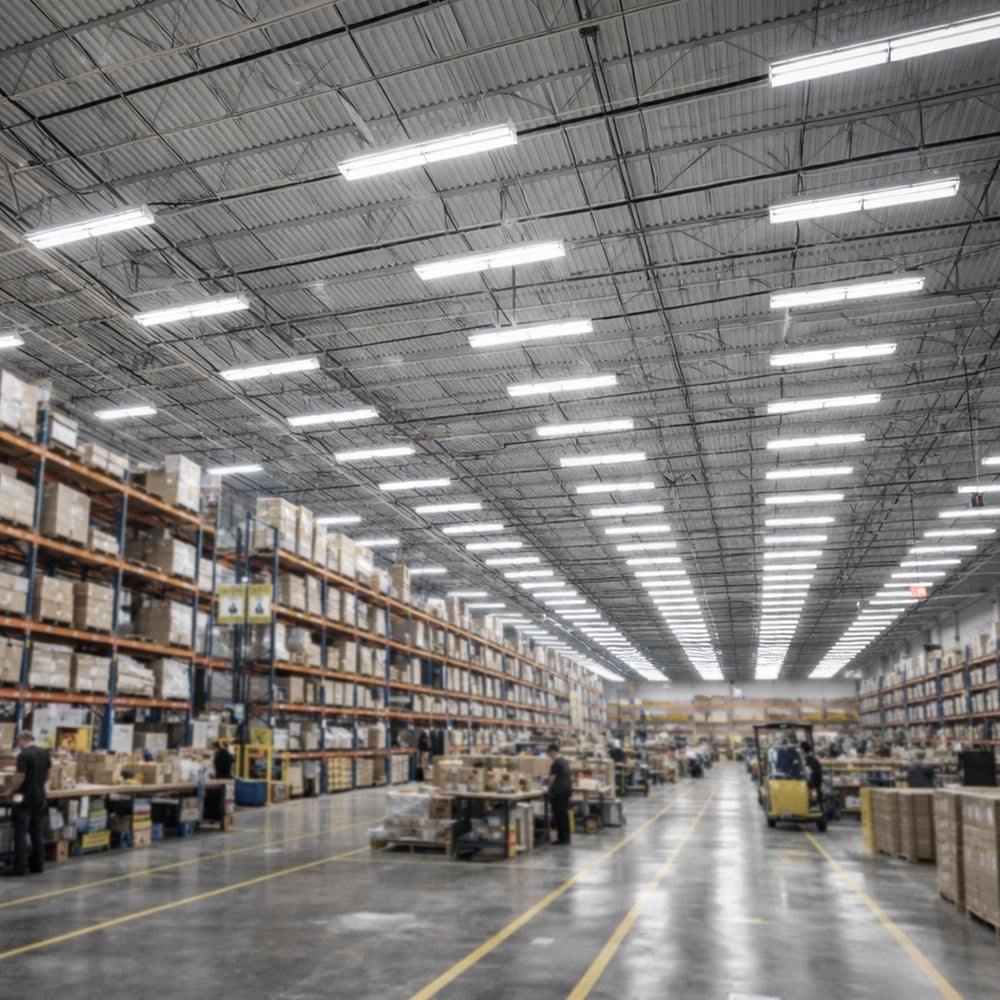
Warehouse LED lighting encompasses the high-output, industrial-grade fixtures engineered to illuminate the vast, high-ceiling environments where goods are stored, sorted, packed, and shipped. These aren't oversized shop lights — they're purpose-built systems designed to deliver powerful, uniform illumination across tens of thousands of square feet while standing up to the demanding conditions of modern logistics, distribution, and storage operations.
Whether you're lighting a 10,000 square foot storage facility, a 500,000 square foot distribution center, a cold storage warehouse, a manufacturing floor, or a multi-level racking operation, the right LED fixtures directly impact worker safety, operational efficiency, picking accuracy, and your bottom line.
PrimeLights offers a complete range of commercial and industrial LED warehouse lighting solutions trusted by facility managers, logistics operators, and warehouse owners across the country. Our fixtures deliver the output, durability, and energy efficiency that high-volume operations demand — backed by expert consultation to help you spec exactly what your facility needs.
Why LED Lighting Is the New Standard for Warehouses in 2026
The warehouse and logistics sector has undergone a massive LED conversion over the past decade, driven by undeniable economics. Warehouses are among the most energy-intensive lighting environments in commercial real estate — large footprints, high ceilings, and long operating hours create enormous energy bills that legacy lighting technologies amplify.
Warehouses that have completed LED conversions consistently report energy cost reductions of 50-75%, maintenance cost elimination of up to 90%, measurable improvements in picking accuracy and worker productivity, and significant reductions in workplace accidents related to poor visibility.
With utility rebate programs actively incentivizing LED upgrades and energy costs continuing to rise, the business case for warehouse LED lighting has never been stronger.
Why Traditional Warehouse Lighting Falls Short
Legacy lighting technologies were designed for an era before modern warehouse operations demanded the speed, precision, and round-the-clock performance that today's supply chains require.
Warehouse Lighting Technology Comparison
TechnologyLifespanEnergy UseWarm-Up TimeMaintenance BurdenEfficiency (lm/W)Metal Halide6,000-15,000 hrsVery High5-15 minHigh (frequent relamping at height)50-90 lm/WHigh Pressure Sodium10,000-24,000 hrsHigh3-10 minModerate50-130 lm/WFluorescent T5HO15,000-20,000 hrsModerate1-3 minModerate70-100 lm/WLED Warehouse Lighting50,000-100,000 hrsVery LowInstantVery Low130-200+ lm/W
Metal Halide: The Costly Legacy Standard. Metal halide high bays have been the dominant warehouse fixture for decades, and they carry enormous hidden costs. The 5-15 minute warm-up time means lights cannot be cycled on and off — they run continuously whether the aisle is occupied or not. Any power interruption leaves workers in complete darkness during the restrike period, creating serious safety hazards around forklifts and heavy equipment. Lumen depreciation is severe, with fixtures losing 30-40% of their output halfway through their rated life, meaning your warehouse gets progressively dimmer between expensive relamping cycles.
High Pressure Sodium: Poor Visibility Disguised as Efficiency. HPS fixtures deliver a distinctive yellow-orange light with terrible color rendering (CRI 20-30). Workers cannot accurately read labels, identify color-coded products, or distinguish items visually — leading to picking errors, misshipments, and quality issues. The warm-up delay creates the same safety concerns as metal halide.
Fluorescent T5HO: Not Built for Height. Fluorescent high-output fixtures struggle to project light effectively at mounting heights above 20 feet. They're temperature-sensitive, losing output in both cold storage and hot upper-level warehouse environments. The lamps are fragile, and the ballasts are a common failure point that drives ongoing maintenance costs.
Key Advantages of LED Lighting for Warehouses
1. Massive Energy Savings at Scale
Warehouses operate lights across enormous square footage for extended hours — often 16-24 hours per day in distribution and fulfillment operations. LED fixtures consume 50-75% less electricity than metal halide and HPS equivalents, and the savings compound dramatically at warehouse scale.
Annual Energy Cost Comparison (per fixture, 18 hrs/day warehouse operation)
Fixture TypeWattageAnnual kWhAnnual Cost @ $0.12/kWhMetal Halide High Bay400W2,628 kWh$315.36HPS High Bay250W1,643 kWh$197.10LED High Bay (Equivalent Output)150W986 kWh$118.26Annual Savings vs. Metal Halide1,642 kWh$197.10
For a warehouse with 200 high bay fixtures, that's over $39,000 in annual energy savings — and that's before factoring in maintenance elimination, utility rebates, or demand charge reductions.
2. Maintenance Elimination in Hard-to-Reach Locations
Relamping fixtures mounted at 30-40 feet in a warehouse isn't just expensive — it's disruptive and dangerous. It requires scissor lifts or boom lifts, disrupts operations in the affected area, and creates safety risks for maintenance workers and warehouse staff below. LED fixtures rated for 50,000-100,000 hours eliminate this cycle entirely. At 18 hours of daily operation, a 50,000-hour fixture lasts over 7 years without a single lamp change.
3. Instant-On Enables Smart Energy Management
Because LED fixtures reach full brightness instantly, warehouses can deploy motion sensors, daylight harvesting, and zone-based scheduling that are impossible with metal halide or HPS. Occupancy-based controls in warehouse aisles typically reduce energy consumption by an additional 40-60% beyond the base LED savings — turning lights on only when a picker or forklift enters the aisle and dimming them when the area is unoccupied.
4. Superior Light Quality Reduces Errors and Accidents
LED fixtures deliver CRI values of 80-90+, meaning labels, color codes, product markings, and safety signage are clearly visible and accurately rendered. Better light quality directly correlates with reduced picking errors, fewer misshipments, and lower accident rates. Workers experience less eye strain and fatigue during long shifts, and the uniform, flicker-free illumination eliminates the headache-inducing buzz and strobe effects common with aging fluorescent and HID fixtures.
5. Full Performance in Extreme Temperatures
Warehouses span the full temperature spectrum — from freezer and cold storage facilities at -20°F to non-climate-controlled buildings that reach 120°F+ at ceiling level in summer. LED fixtures maintain consistent output across this entire range, unlike fluorescent fixtures that dim or fail in cold temperatures and HID fixtures that degrade faster in excessive heat.
6. Directional Light Output Maximizes Useful Illumination
LED fixtures emit light directionally, focusing output downward where it's needed on work surfaces, aisle floors, and racking faces. Traditional HID fixtures emit light in all directions, with a significant percentage wasted upward toward the ceiling or sideways into unused space. This directional efficiency means LED fixtures can achieve the same effective illumination at the work surface using significantly lower wattage.
7. Reduced Cooling Costs
In climate-controlled warehouses and distribution centers, the heat generated by lighting directly increases HVAC load. LED fixtures produce dramatically less heat than metal halide and HPS alternatives — reducing cooling costs in addition to the direct energy savings from the fixtures themselves. In large facilities, this secondary savings can be substantial.
Types of LED Fixtures for Warehouse Applications
UFO High Bay LED Lights
Best For: Open warehouse floors, distribution center staging areas, loading zones, gymnasiums, large retail spaces, manufacturing floors
UFO (round) high bays are the most popular warehouse fixture format, delivering powerful, concentrated downward illumination from a compact, lightweight form factor. Their round design provides symmetrical light distribution ideal for open floor areas where wide, even coverage is needed from fewer mounting points.
Typical output ranges from 15,000 to 50,000+ lumens, with mounting heights of 20-45+ feet. Many UFO high bays feature built-in occupancy sensors and daylight harvesting capabilities, simplifying smart lighting implementation.
Linear High Bay LED Lights
Best For: Aisle lighting between racking, narrow storage corridors, assembly lines, manufacturing areas with linear workflows
Linear high bays distribute light along their length rather than in a circular pattern, making them the preferred choice for warehouses with racked storage. Mounted directly above aisles, linear fixtures provide uniform illumination down the full length of storage rows, lighting both the aisle floor and the racking faces where pickers need to read labels and identify products.
Linear high bays are also preferred for manufacturing and assembly areas where workstations are arranged in rows and consistent, shadow-free illumination along the line is critical.
LED Strip / Shop Lights
Best For: Receiving areas, packing stations, break rooms, offices within warehouses, maintenance shops, lower-ceiling mezzanine areas
For warehouse areas with standard ceiling heights (8-15 feet), 4-foot and 8-foot LED shop lights and strip fixtures provide efficient, cost-effective illumination. These are ideal for the functional spaces adjacent to the main warehouse floor — receiving docks, packing lines, shipping offices, break rooms, and maintenance shops. Linkable designs simplify installation in areas with limited wiring infrastructure.
LED Vapor Tight Fixtures
Best For: Cold storage, freezer warehouses, food and beverage storage, car wash facilities, any high-moisture environment
Vapor tight fixtures sealed to IP65 or higher are essential for cold storage and freezer operations where temperature differentials create condensation, and for food and beverage warehouses where washdown cleaning is routine. These sealed fixtures prevent moisture intrusion that would destroy standard fixtures and maintain full output in sub-zero temperatures where other technologies fail.
LED Panel and Troffer Lights
Best For: Warehouse offices, conference rooms, administrative areas, control rooms, break rooms
For the office and administrative spaces within warehouse facilities, LED flat panel and troffer fixtures provide clean, uniform, professional-grade illumination. Available in standard drop-ceiling sizes (2x2 and 2x4 feet), they integrate seamlessly with existing ceiling grids.
LED Wall Packs and Flood Lights
Best For: Loading docks, truck courts, building exteriors, parking areas, perimeter security
Exterior warehouse lighting is critical for safe loading and unloading operations, truck maneuvering, and facility security. LED wall packs and flood lights provide powerful, energy-efficient illumination for building perimeters, dock areas, and parking lots.
LED Canopy Lights
Best For: Covered loading docks, drive-through areas, fuel canopies, covered walkways
Canopy-mounted fixtures provide downward illumination for covered exterior areas. At loading docks, they ensure safe product handling and truck loading during nighttime and early morning shifts.
LED Area / Parking Lot Lights
Best For: Truck courts, employee parking, facility perimeter, outdoor staging areas
Pole-mounted area lights deliver wide coverage for the expansive outdoor areas surrounding warehouse facilities. They're essential for truck courts where trailers are staged and maneuvered, employee parking areas where shift workers arrive and depart in darkness, and perimeter security.
Emergency and Exit Lighting
Best For: All warehouse areas — required by code
Emergency lighting and illuminated exit signage are code-required in all commercial warehouse facilities. LED emergency fixtures provide automatic illumination during power failures, guiding workers safely to exits. Battery backup options ensure continued operation during outages.
Explosion Proof / Hazardous Location Lighting
Best For: Chemical storage warehouses, paint and solvent storage, grain and flour storage, facilities handling combustible dust or flammable vapors
Warehouses storing hazardous materials, combustible dusts, or flammable liquids require fixtures rated for the specific hazard classification. Explosion-proof LED fixtures meet NEC Class I (gases/vapors) and Class II (dusts) requirements while delivering the efficiency and longevity benefits of LED technology.
How to Choose the Right LED Fixture for Your Warehouse: Technical Specifications Explained
Understanding Lumens: How Much Light Does Your Warehouse Need?
Warehouse lighting requirements vary significantly based on the activity being performed. Under-lighting creates safety hazards and reduces productivity; over-lighting wastes energy and budget. Use these guidelines to plan appropriate illumination for each zone:
Warehouse ZoneRecommended Lumens per Sq FtIES Recommended Foot-CandlesBulk / inactive storage10-20 lumens/sq ft5-10 fcActive storage / general warehousing20-30 lumens/sq ft10-20 fcPicking and sorting areas30-50 lumens/sq ft20-30 fcPacking and shipping stations50-70 lumens/sq ft30-50 fcReceiving and inspection areas50-75 lumens/sq ft30-50 fcAssembly / manufacturing areas50-100 lumens/sq ft30-50 fcLoading dock interiors30-50 lumens/sq ft20-30 fcOffice and administrative areas40-60 lumens/sq ft30-50 fc
Color Temperature (Kelvin): Matching Light to Warehouse Operations
Color temperature selection affects worker alertness, visual acuity, and overall comfort during long shifts:
4000K (Neutral White): Balanced white light that provides good visibility with a slightly warmer feel. Sometimes preferred for warehouses where employees work extended shifts, as it's less fatiguing than cooler temperatures over long periods.
5000K (Daylight): The most popular choice for warehouse environments. Crisp, bright illumination that maximizes visibility, alertness, and color accuracy. Closely resembles natural daylight and is recommended for picking, packing, inspection, and any area where visual accuracy matters.
5000K-6500K (Cool Daylight): Maximum brightness and alertness. Suitable for inspection areas and quality control zones. Some workers find this range harsh for full-shift exposure.
Expert Recommendation: 5000K is the standard for warehouse environments, delivering the optimal balance of visibility, alertness, and worker comfort. PrimeLights fixtures with selectable color temperature (CCT) let you dial in the right tone after installation.
CRI (Color Rendering Index): Impact on Warehouse Operations
In a warehouse, CRI directly affects the ability to read labels, identify products, match color codes, spot damage, and perform quality inspection:
CRI 70-79: Acceptable for basic storage areas where color accuracy is not critical.
CRI 80-89: The standard for most warehouse operations. Labels, color codes, and product markings are clearly distinguishable. Recommended for picking, packing, and general warehousing.
CRI 90+: Essential for quality inspection areas, pharmaceutical and cosmetic warehouses, food grading, and any application where precise color differentiation impacts product quality or compliance.
Ceiling Height and Fixture Selection for Warehouse Environments
Warehouses feature some of the tallest commercial ceiling heights, and matching fixture output to mounting height is critical for achieving adequate light at the floor and racking level:
Clear HeightTypical Warehouse TypeRecommended FixtureLumen Output per Fixture12-20 ftSmall warehouses, mezzanines, storage roomsLow bay / linear fixtures10,000-20,000 lumens20-30 ftStandard distribution, general warehousingUFO or linear high bays20,000-30,000 lumens30-40 ftModern distribution centers, bulk storageHigh-output high bays30,000-45,000 lumens40-50+ ftLarge DCs, cold storage, mega-warehousesMaximum-output high bays45,000-60,000+ lumens
Understanding IP Ratings for Warehouse Environments
Different warehouse zones require different levels of environmental protection:
IP RatingProtection LevelWarehouse ApplicationsIP20Basic (indoor only)Climate-controlled offices, dry storageIP44Splash protectionGeneral dry warehousing, break roomsIP65Dust-tight, water jet resistantCold storage, food/beverage, washdown areasIP66Dust-tight, powerful water jetFreezers, food processing, aggressive cleaningIP67Dust-tight, temporary immersionExtreme cold storage, flood-prone dock pits
Warehouse LED Lighting Applications: Zone-by-Zone Guide
High-Ceiling General Warehousing
The main warehouse floor is where the bulk of your lighting investment goes. For standard clear heights of 24-36 feet, UFO high bays in the 25,000-40,000 lumen range provide the most efficient coverage. Space fixtures on a grid pattern that accounts for the beam angle and mounting height to achieve uniform illumination without dark spots between fixtures. For warehouses running 16+ hours per day, the energy savings of LED over metal halide are enormous.
Racked Storage Aisles
Narrow aisle warehouses with selective, double-deep, or drive-in racking present a specific challenge: light needs to reach both the aisle floor and the vertical racking faces where labels must be readable at all heights. Linear high bays mounted directly above each aisle deliver targeted illumination down the full aisle length. This is where occupancy-sensor-equipped fixtures shine — aisles are frequently unoccupied, and motion-triggered lighting can cut energy use in racking zones by 50-60%.
Picking and Sorting Zones
Pick zones demand higher light levels (30-50 lumens/sq ft) and excellent color rendering (CRI 80+) because workers are reading labels, scanning barcodes, and visually identifying products at speed. Uniform, shadow-free illumination reduces picking errors and improves throughput. For facilities using barcode scanners and vision systems, consistent, high-quality lighting also improves scan rates and accuracy.
Packing and Shipping Stations
These workstations operate at task-lighting intensity levels (50-70 lumens/sq ft), typically under lower ceiling heights. LED shop lights or low bay fixtures provide focused illumination for label reading, quality checks, and packaging operations. Consider supplemental task lighting at individual pack stations for additional precision.
Receiving and Inspection Areas
Receiving docks require bright, high-CRI lighting for inspecting incoming shipments — checking for damage, verifying quantities, and confirming product quality. This is often where the highest CRI (85+) in the facility is specified, since detecting damage or discrepancies depends on accurate visual assessment.
Loading Docks (Interior and Exterior)
Loading docks are high-traffic, high-hazard zones where forklifts, pallet jacks, dock plates, and personnel converge. Interior dock lighting needs to be bright enough to safely navigate the transition between the lit warehouse interior and the darker dock area. Exterior dock lighting — wall packs and canopy fixtures — illuminates truck courts and trailer interiors during nighttime loading. Dock lights should be rated for the temperature and moisture exposure of the semi-outdoor environment.
Cold Storage and Freezer Warehouses
Cold storage is one of the most demanding environments for any lighting system. Temperatures ranging from 35°F in coolers to -20°F or colder in deep freezers destroy fluorescent fixtures and significantly degrade HID performance. LED fixtures with IP65+ ratings and cold-temperature operational specs are the only reliable choice. Vapor tight construction prevents the condensation and ice formation that plague unsealed fixtures in cold storage environments. The instant-on capability is especially valuable — workers entering and exiting cold zones need immediate full lighting without warm-up delays.
Manufacturing and Assembly Areas
For warehouses that incorporate manufacturing or assembly operations, lighting requirements step up to 50-100 lumens per square foot with CRI 80-90+ for detailed work. High bay fixtures provide ambient illumination while supplemental task lighting may be added at individual workstations. Consider higher color temperatures (5000K-6500K) in inspection and quality control zones for maximum visual acuity.
Warehouse Office and Administrative Spaces
Office areas within warehouse facilities use the same lighting principles as standard commercial offices — LED flat panel and troffer fixtures providing 40-60 lumens per square foot of uniform, glare-free illumination at 4000K-5000K. These spaces benefit from dimmable fixtures that allow occupants to adjust comfort levels.
Parking and Perimeter
Exterior warehouse lighting addresses both safety and security. Employee parking areas need sufficient illumination (typically 1-5 foot-candles) for safe pedestrian movement during early morning and late evening shift changes. Perimeter lighting deters unauthorized access and supports security camera systems. Pole-mounted LED area lights and building-mounted wall packs are the standard solutions, with photocell and motion-sensor controls for energy efficiency.
Smart Warehouse Lighting: Controls and Energy Management
Occupancy / Motion Sensors
Occupancy-based controls are the single most impactful energy-saving strategy for warehouse lighting beyond the base LED conversion. In a typical warehouse, most aisles and zones are unoccupied the majority of the time. Motion sensors automatically bring fixtures to full output when a worker or forklift enters an area and dim to a low standby level (or shut off entirely) after the area is vacated. Facilities implementing occupancy controls routinely achieve 40-60% additional energy savings beyond the LED conversion itself.
Daylight Harvesting
Warehouses with skylights or translucent wall panels can use daylight-harvesting sensors to automatically dim LED fixtures when natural light is sufficient. Photosensors measure ambient light levels and adjust fixture output accordingly, reducing energy consumption during daylight hours without any manual intervention.
Zoned Scheduling
Different warehouse zones operate on different schedules. Shipping docks may run 6 AM to midnight while bulk storage areas are only accessed during a single shift. Programmable lighting controls allow zone-by-zone scheduling that matches light output to actual operational hours, eliminating the energy waste of lighting unoccupied zones.
Networked Lighting Controls
Advanced warehouse lighting systems connect fixtures to a central management platform, enabling remote monitoring, scheduling, dimming, and energy tracking across the entire facility. Facility managers can monitor fixture health, track energy consumption by zone, adjust lighting levels remotely, and receive alerts for fixture failures — all from a dashboard or smartphone app.
Installation Planning for Warehouse LED Lighting
Calculating Your Lighting Needs
Before specifying fixtures, calculate the requirements for each zone in your facility:
- Measure the total square footage of each zone (main floor, picking areas, packing stations, docks, offices).
- Determine the required lumens per square foot based on the function of each zone (see tables above).
- Divide total lumens needed by the output of your chosen fixture to determine fixture count.
- Plan fixture layout to achieve uniform coverage, accounting for beam angle and mounting height.
Example: A 50,000 sq ft warehouse floor with 30-foot clear height requiring 30 lumens/sq ft needs 1,500,000 total lumens. Using 30,000-lumen high bay fixtures: 1,500,000 ÷ 30,000 = 50 fixtures distributed on an even grid pattern.
Mounting Considerations for Warehouse Ceilings
Pendant/Chain Mount: The most common warehouse installation method. Fixtures hang from chains or aircraft cables attached to roof structure, allowing height adjustment to optimize illumination.
Surface/Flush Mount: Direct attachment to the ceiling deck. Used when maximum headroom is needed or ceiling heights are lower.
Hook Mount: Quick-installation option using V-hooks or carabiner clips. Popular for smaller fixtures and spaces where maintenance access is a priority.
Electrical Considerations for Warehouse Scale
Warehouse lighting installations involve significant electrical load. Key planning considerations:
Voltage Selection: While 120V is standard for small facilities, most warehouses benefit from 277V or 480V fixtures. Higher voltage means lower amperage, allowing smaller wire gauges, longer runs without voltage drop, and more fixtures per circuit — reducing electrical infrastructure costs significantly.
Circuit Planning: Calculate total connected wattage per circuit, accounting for all fixtures plus a safety margin. A 20-amp 277V circuit can support approximately 4,400 watts (typically 25-30 high bay fixtures at 150W each).
Emergency Power: Building codes require emergency egress lighting. Specify fixtures with integrated battery backup or connect a portion of the lighting system to the facility's emergency generator.
Control Wiring: If implementing occupancy sensors, daylight harvesting, or networked controls, plan low-voltage control wiring or wireless control infrastructure during the installation phase.
Safety Note: Warehouse electrical installations should be performed by licensed commercial electricians in accordance with NEC, NFPA, and local building codes.
Retrofit vs. New Construction
Retrofit (Replacing Existing Fixtures): Most warehouse LED upgrades are retrofits replacing existing metal halide, HPS, or fluorescent fixtures. Options include one-for-one fixture replacement (removing old fixtures and installing new LED fixtures on existing mounting points) or retrofit kits that convert existing fixture housings to LED. One-for-one replacement is typically preferred for the cleanest installation and best performance.
New Construction: New warehouse builds offer the advantage of designing the lighting system from scratch — optimizing fixture placement, circuiting, and controls without the constraints of existing infrastructure. This typically results in fewer, higher-output fixtures compared to retrofitting a layout designed for less efficient legacy technology.
The ROI of Warehouse LED Lighting
Calculating Payback Period
The payback calculation for warehouse LED lighting is straightforward and compelling:
Step 1: Calculate current annual lighting energy cost (total fixture watts × daily operating hours × 365 × electricity rate per kWh).
Step 2: Calculate projected LED annual energy cost using the same formula with LED fixture wattages.
Step 3: Subtract to find annual energy savings.
Step 4: Add annual maintenance cost savings (lamp replacements, lift rentals, labor, downtime).
Step 5: Subtract any utility rebates or incentives from the total project cost.
Step 6: Divide net project cost by total annual savings (energy + maintenance) to determine payback in years.
Most warehouse LED conversions achieve payback in 12-24 months, with facilities running 16+ hours per day often seeing payback under 12 months. Beyond the payback period, every dollar saved goes directly to the bottom line for the remaining 7-10+ years of fixture life.
Utility Rebates and Incentives
Most major utilities offer prescriptive or custom rebates for commercial LED lighting upgrades. Rebates of $25-$100+ per fixture are common and can offset 20-40% of project costs. Your PrimeLights lighting specialist can help identify available programs in your service territory and provide the documentation needed to secure rebates.
The Future of Warehouse LED Lighting: 2026 and Beyond
Warehouse lighting is evolving rapidly alongside broader logistics and automation trends:
IoT Integration: LED fixtures serving as nodes in a warehouse-wide sensor network, providing occupancy data, environmental monitoring, and asset tracking alongside illumination.
LiFi (Light Fidelity): Emerging technology that uses LED light to transmit data, potentially providing indoor positioning and communication capabilities through the existing lighting infrastructure.
AI-Driven Optimization: Machine learning algorithms analyzing occupancy patterns and operational data to automatically optimize lighting schedules, levels, and energy consumption across the facility.
Human-Centric Lighting: Tunable systems that adjust color temperature and intensity throughout shifts to support worker alertness, reduce fatigue, and improve safety — particularly valuable for facilities running overnight operations.
Ultra-High Efficiency: LED chip technology pushing above 200 lumens per watt, continuing to drive down the energy cost per lumen and accelerating payback periods for new installations and upgrades.
Frequently Asked Questions About Warehouse LED Lighting
What type of LED light is best for a warehouse?
For the main warehouse floor with ceiling heights of 20-40+ feet, UFO high bay LED fixtures are the most popular and cost-effective choice. For racked storage aisles, linear high bays provide better directional coverage along the aisle length. Most warehouse operations spec 5000K color temperature with CRI 80+ for optimal visibility and worker alertness.
How many lumens do I need for a warehouse?
It depends on the activity. Bulk storage needs 10-20 lumens per square foot, general active warehousing needs 20-30 lumens/sq ft, and picking and packing areas need 30-50+ lumens/sq ft. A 50,000 sq ft active warehouse at 30 lumens/sq ft requires 1,500,000 total lumens — approximately 50 fixtures at 30,000 lumens each.
How do I light a warehouse with high racking?
Mount linear high bay LED fixtures directly above each aisle, centered between racking rows. This delivers targeted illumination to both the aisle floor and the vertical racking faces where labels must be readable. For very narrow aisles (VNA), fixture beam angles should be matched to the aisle width to maximize useful light and minimize spill into adjacent aisles.
Can LED warehouse lights work in cold storage?
Yes — LED fixtures are the ideal choice for cold storage and freezer environments. Unlike fluorescent fixtures that fail in cold temperatures, LEDs maintain full output at -20°F and below. Specify fixtures rated IP65 or higher with listed cold-temperature operating ranges to prevent condensation and ice buildup. Vapor tight construction is essential.
How much can I save by switching my warehouse to LED?
A typical 200-fixture warehouse switching from 400W metal halide to 150W LED high bays operating 18 hours per day saves approximately $39,000+ per year in energy costs alone. Adding maintenance savings (eliminated relamping, lift rental, labor, and downtime) typically brings total annual savings to $45,000-$55,000+. Most conversions pay for themselves in 12-24 months.
Do I need occupancy sensors in my warehouse?
While not code-required in all jurisdictions, occupancy sensors are the highest-ROI addition to any warehouse LED installation. Aisles and zones that are unoccupied most of the time represent pure energy waste when lit at full power. Motion-based controls reduce consumption in those zones by 40-60%, often cutting the payback period for the entire LED project in half.
What is the difference between UFO and linear high bay lights?
UFO high bays are round, compact fixtures that project light in a symmetrical circular pattern — ideal for open floor areas. Linear high bays are rectangular and distribute light along their length — ideal for aisle lighting between racking. Most warehouses use a combination: UFOs for open staging, receiving, and shipping areas, and linear fixtures for racked storage aisles.
What voltage should I use for warehouse lighting?
For small warehouses with limited fixtures, 120V is workable. For most commercial warehouses, 277V is the standard — it allows more fixtures per circuit, smaller wire gauges, and longer runs without voltage drop. Large industrial facilities with 480V three-phase service can use 480V fixtures for maximum electrical efficiency. Verify available voltage at your facility's distribution panels before specifying fixtures.
How do I calculate how many warehouse LED fixtures I need?
Use this formula: (Square Footage × Required Lumens per Sq Ft) ÷ Lumens per Fixture = Number of Fixtures. Then adjust for layout uniformity — you may need to add or reposition fixtures to eliminate dark spots between mounting points. Your PrimeLights lighting specialist can provide a photometric layout for precise fixture placement.
Are there rebates available for warehouse LED upgrades?
Yes. Most major utilities offer rebates for commercial LED conversions, typically $25-$100+ per fixture depending on the wattage reduction achieved. Many states also offer additional incentives through energy efficiency programs. Rebates can offset 20-40% of project costs. PrimeLights can help identify available programs in your area and provide documentation for rebate applications.
Why Choose PrimeLights for Your Warehouse LED Lighting
PrimeLights has been a trusted name in commercial and industrial LED lighting since 2010, with over 150,000 satisfied customers across every type of demanding work environment — including warehouses and distribution centers of every size.
Industrial-Grade Performance: Our warehouse fixtures are built for continuous-duty operation in demanding environments — high heat at ceiling level, cold storage extremes, dust, moisture, and vibration. These are commercial fixtures, not residential products with inflated specs.
Complete Warehouse Product Range: From high-output high bays and aisle-specific linear fixtures to dock lights, exterior area lights, and emergency systems — we provide every fixture type a warehouse needs from a single trusted source.
Expert Warehouse Lighting Consultation: Our lighting specialists understand warehouse operations and can help you calculate fixture counts, select the right products for each zone, and plan layouts that maximize illumination and energy efficiency.
Industry-Leading Warranties: We stand behind our products with comprehensive warranties that reflect confidence in fixture quality and the realities of warehouse operating conditions.
Volume and Contractor Pricing: Warehouse projects involve significant fixture quantities. Our volume pricing and contractor programs make professional-grade LED lighting cost-effective for facilities of any size.
Get Started with PrimeLights Warehouse LED Lighting
Ready to upgrade your warehouse or distribution center with energy-efficient LED lighting? Contact the PrimeLights team today for personalized recommendations based on your facility's dimensions, ceiling heights, operational requirements, and budget.
Our lighting experts can help you:
- Calculate optimal fixture count and layout for each zone in your facility
- Select the right fixture type, lumen output, beam angle, and color temperature for each application
- Estimate energy and maintenance cost savings versus your current lighting
- Provide photometric layouts for uniform, code-compliant illumination
- Develop custom quotes for single-facility or multi-location projects
- Identify available utility rebates and energy incentive programs

Collection:
Warehouse Lighting Fixtures
About Warehouse LED Lights
It’s widely known that LED lights can save businesses significant amounts of money on utility costs with their high-degree of energy efficiency, but did you know they’re also ideal for faculties with high ceilings and few windows? That’s right! With their low heat-distribution and bright even-lighting, our LED fixtures make great warehouse lights, and can bring much needed light to your space without effecting the temperature. This can facilitate maximum productivity and safety, which is essential when working with heavy equipment and short timeframes.
Need help upgrading your warehouse lighting?
Contact us for a professional lighting layout for your warehouse. We'll take your building's surface area, mounting height, and preferred lighting levels into account to provide a custom recommendation. These only take a few minutes and are completely free. Contact us now to get started!
Get Your High Bay LED Lighting Fixtures from PrimeLights
For more information about our selection of commercial LEDs for warehouses and other industrial facilities, contact our team today. We can answer all your questions about our commercial LED lighting fixtures and and help you find the perfect match for your warehouse lighting needs.